See the AI mark a real answer sheet
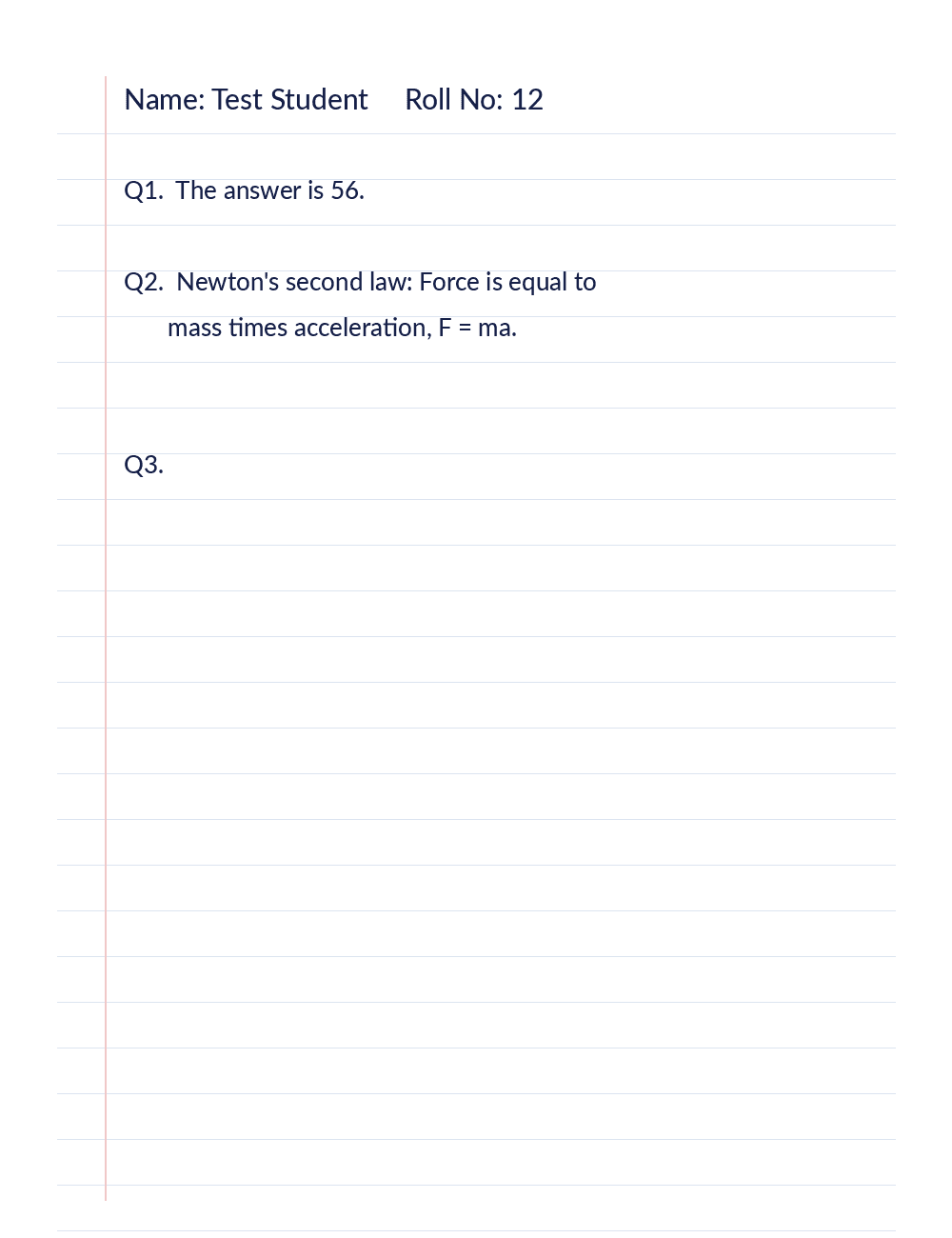
This is exactly what you get after you solve a paper by hand and snap a photo: every answer marked against a real scheme, partial credit, and the precise concepts to revise. The score below was produced by our grading AI on the handwritten sheet shown here.
The handwritten answer sheet
Science — Mixed Quick Quiz
An honest, board-style score across the whole paper — answering one question well is not 100%.
Focus next on
- • Photosynthesis — the entire topic needs attention; practise the balanced equation and the step-by-step process.
- • Newton's Second Law in its complete momentum form — move beyond F = ma to F = rate of change of momentum.
- • Exam strategy — always attempt every question; partial credit is available for partial knowledge.
Answer-by-answer feedback
Options: (a) 54 (b) 56 (c) 58 (d) 63
You wrote: The answer is 56.
✓ Right: Correctly identified 56 as the product of 7 × 8. Clear, confident answer.
△ Missed: Nothing — full marks!
→ Tip: Great job! For MCQs, it also helps to briefly eliminate the wrong options in your mind (e.g., 7×7=49, 7×9=63) to double-check before writing.
You wrote: Newton's second law: Force is equal to mass times acceleration, F = ma.
✓ Right: Correctly stated F = ma and explained it as Force equals mass times acceleration. This earns the first rubric mark.
△ Missed: The second mark requires stating the law in its more complete form: that force equals the rate of change of momentum (F = Δp/Δt), and that this net force acts in the direction of the change. F = ma is a special case for constant mass, but the full law is about momentum.
→ Tip: Try to write: 'The net force on an object equals the rate of change of its momentum, and acts in the direction of that change. For constant mass, this gives F = ma.' That two-part statement will always fetch both marks.
Revise: Newton's Second Law — momentum form (F = dp/dt), Relationship between momentum and force, Laws of Motion — Chapter 5 (NCERT Physics)
You wrote: Question number written but no answer provided — left blank.
✓ Right: N/A — question was not attempted.
△ Missed: All three marks: (1) the role of sunlight and chlorophyll in capturing light energy; (2) the conversion of CO₂ and water into glucose and oxygen; (3) the balanced chemical equation 6CO₂ + 6H₂O → C₆H₁₂O₆ + 6O₂.
→ Tip: Don't leave a question blank — even a partial attempt can earn marks. For photosynthesis, try to remember the mnemonic 'Sun + Water + CO₂, Chlorophyll helps, out comes Glucose + O₂.' Practise writing the balanced equation a few times until it feels natural.
Revise: Photosynthesis — light and dark reactions, Role of chlorophyll in light absorption, Balanced chemical equation for photosynthesis, Reactants and products of photosynthesis (Chapter 6, Life Processes — NCERT Biology)
Get your own answers graded like this
Generate a Science paper (or any subject) on the chapters you choose, write it by hand, upload a photo, and get this exact breakdown — 3 free evaluations a month, no card required.